
Original
No. S-2026-0001
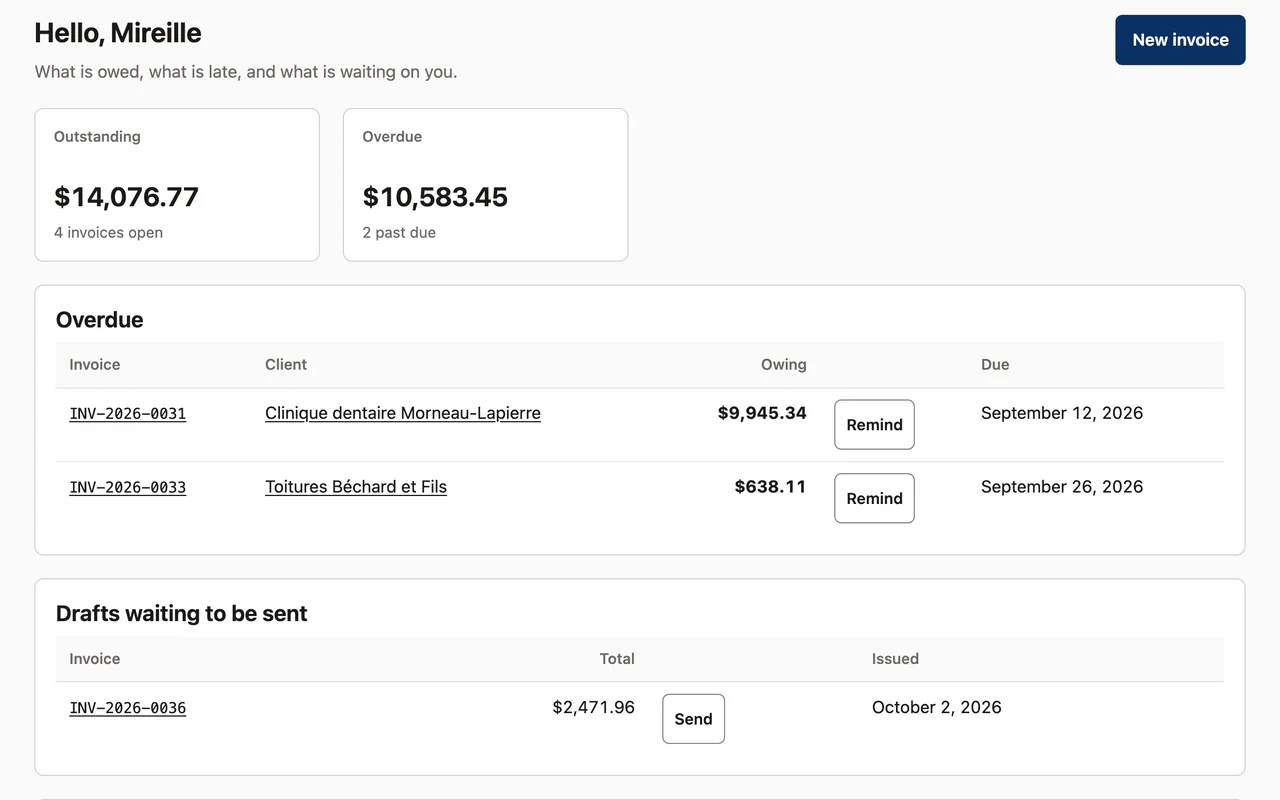
Your proposals get signed.
Your invoices get paid.
Relais Studio Pay sends the proposal, takes the signature, raises the invoice and collects the payment, once, or every month. Your client creates no account: they open a link.
Signature
Ask for a walkthrough| Website design and build | $6,400.00 |
| Product photo session (optional) | $950.00 |
| Hosting and maintenance | $85.00 / month |
| Total due on acceptance | $6,400.00 |
On your domain. No logo on it but yours.
Copy
Three moves, and it is paid
-
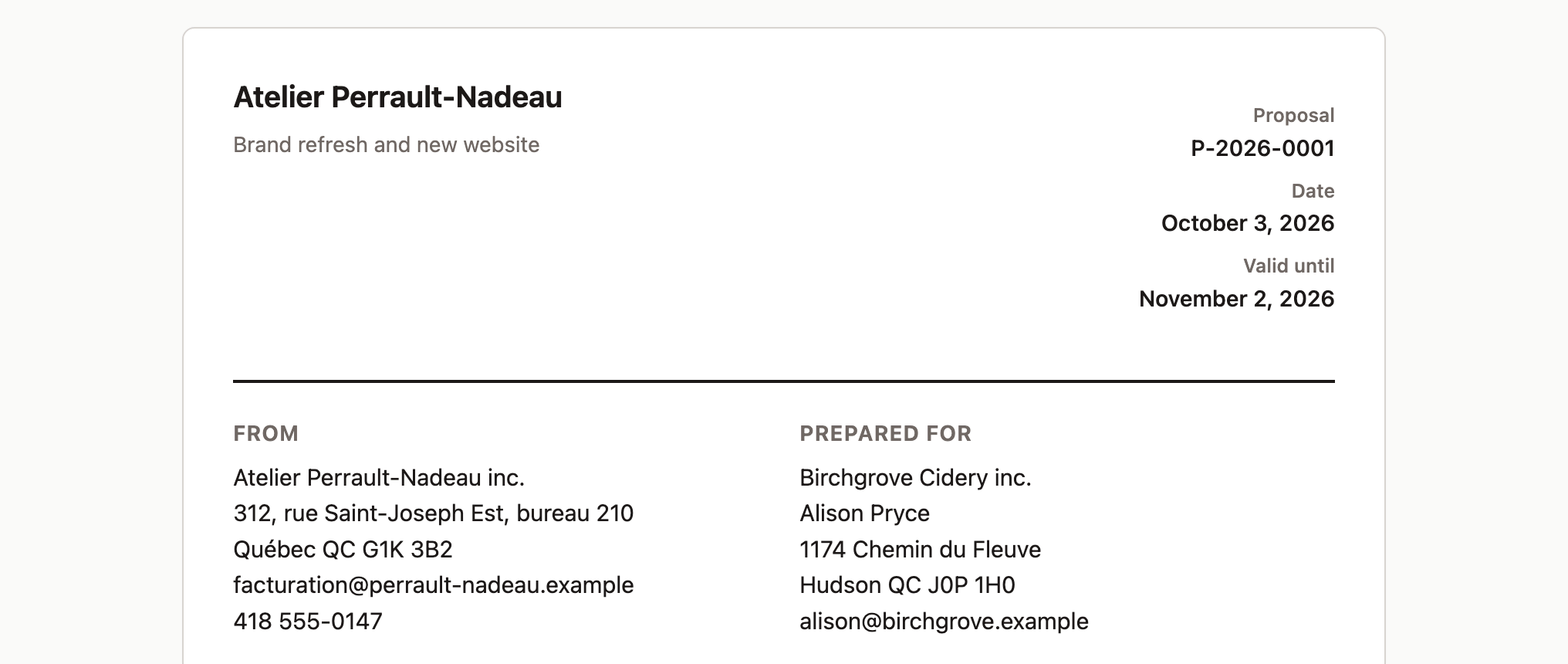
You send
A template, lines from your catalogue, options the client can tick. Totals, taxes and dates work themselves out.
-
They sign
They open their link, pick their options, type or draw their signature. A certificate keeps the SHA-256 fingerprint of the exact document they signed.
-
Money arrives
The invoice goes out on acceptance, the card is charged, and a recurring engagement re-invoices itself every month.
One signature goes through all three leaves: the proposal, the invoice, the payment.
Original
What it actually does
None of this is planned: it is live, and exercised against the deployed product.
-
Proposals that bend
Markdown sections, required lines, optional add-ons and either/or tiers. The client composes, the total follows, and what they accept is recomputed on your side, never on theirs.
-
Electronic signature
Typed name, drawn by mouse or finger, consent stored word for word. The certificate carries the date, the IP address, the reported timezone and the document fingerprint.
-
Invoices and taxes
Several taxes per line, each named with its registration number: GST and QST appear the way they have to. Partial payments, balances, overdue chasing.
-
One-off and recurring
Stripe for the card. A monthly or yearly engagement is born from the accepted proposal and bills itself without anyone remembering; reminders go out on their own.
-
Clients
A record per client: contacts, address, currency and language, with what is owed, what has been received, their invoices and their proposals. CSV import and export.
-
API and webhooks
A JSON API by key, with explicit scopes: a key that lacks one gets a refusal that names the missing scope. Outbound webhooks are signed and retried.
Copy
It never says our name
This is the point of the product: what your client sees carries your brand, not ours, and not the tool’s.
- Company name, colours, logo, numbering prefixes and language change from Settings, with no redeployment.
- The browser tab of an invoice carries your company’s name, not the software’s. A test fails if anyone forgets it.
- The colour you pick decides, by itself, the colour of the text laid on it, so no brand can produce an unreadable button.
- Your own domain, your own database, your own Stripe account.
A copy handed to a client is installed by changing two lines of configuration and one password.
One signature goes through all three leaves: the proposal, the invoice, the payment.
Original
Pricing
The product is installed, hosted and rebranded for you. The price depends on what you want us to carry: the installation alone, or the installation and running it.
What is included
- The instance under your brand, on your domain
- Your catalogue and templates carried over
- Your Stripe account wired in
- The code, yours, documented
Built to last, not to demo
A tool handed to you has to still start in two years, without us.
One Worker
No server to watch, no container, no queue. A SQL database, a trigger every fifteen minutes, and that is the whole of it.
No build step
No client-side framework, no toolchain to repair. The code you read is the code that runs.
Checked live, not only in tests
The suite runs before every release, and every feature is then exercised against the deployed product. Both, always.
Questions
Does my client need an account?
No. They open a link, read their document, choose, sign or pay. The link survives a redeployment.
Do I keep my Stripe account?
Yes, and it is the only arrangement on offer: the money goes straight to you. We are never on the payment path.
Are the documents in French?
By default, yes: labels, amounts and dates are in French, in the Québec format. A deployment can switch to English instead, from Settings › Brand.
What if I want to leave?
The code is yours and the database is a standard SQLite file. There is nothing to retrieve from us, because there is nothing at our end.
What is not in it?
No bookkeeping, no payroll, no timesheets. The tool stops where your accountant starts.
Copy
See it
Tell us in two lines what you send your clients today. We come back with an instance to look at.